_White_Background_square_1920px.png?width=256&height=96&name=FLEETWATCH%20Fleet%20Information%20Technology%20by%20S%26A%20Systems%2c%20Inc%20(06_28_2021)_White_Background_square_1920px.png)
A delivery meter measures inflow. A pump meter measures outflow. The tank gauge measures the quantity remaining. All three are necessary to reconcile the physical movement of product. This method reconciles the entire tank balance rather than comparing two transaction streams while ignoring the physical quantity of product that was in the tank at the beginning and end of the period.
It works like a bank account:
- Beginning inventory = opening bank balance
- Deliveries = deposits
- Pumped gallons = withdrawals
- Ending inventory = closing bank balance
When an accountant audits a bank account, they start with the opening balance and determine whether the ending balance is what it should be after accounting for all deposits and withdrawals.
That is exactly what tank inventory reconciliation does.
So, the preferred methodology is not “deliveries versus pumps” alone. It is:
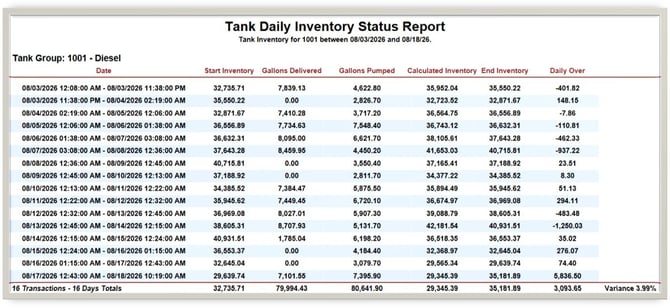
Beginning Inventory + Deliveries − Pumped = Calculated Ending Inventory
and then:
Actual Ending Inventory − Calculated Ending Inventory = Inventory Variance
That approach provides a complete physical reconciliation and can identify discrepancies that a delivered-versus-pumped comparison can miss.
Ideally, with modern tank monitors such as the TLS 450 or EVO 550, coupled with calibrated and well-maintained dispensers, you'd expect to see a variance of 1-2%.
Here’s an example of the calculation in action on one our automated reports for a TLS-250.